
Over the past year, artificial intelligence has moved from buzzword to business reality. For small and mid-sized businesses, the initial promise was seductive and clear: do more with less, automate away repetitive work, and unlock new levels of productivity without proportional hiring. But as AI adoption accelerates across the U.S. economy, the conversation is shifting from optimism to ambivalence. Business leaders and employees alike are asking harder questions: Is AI actually replacing workers, or is it empowering them to do better work? Or is something more nuanced – and more complicated – happening beneath the surface?
The answer, as most thoughtful SMB leaders are discovering, resists the simplicity of either extreme. The truth is messier, more interesting, and ultimately more important to understand.
The Narrative Divide: Job Loss vs. Job Evolution
Recent headlines have painted two starkly different pictures of AI’s impact on work.
On one side sits growing concern that AI is quietly displacing workers, particularly in administrative, HR, and entry-level roles. Some reports suggest companies are reducing headcount while attributing these efficiencies to “AI transformation” – a trend increasingly criticized as “AI washing,” where the real story is cost-cutting dressed up as innovation. These accounts tap into genuine anxiety about technological displacement and ring true to anyone who’s watched industries transform around them.
On the other side, companies like IBM are taking a notably different stance. They’ve publicly announced initiatives not to reduce entry-level hiring, but to expand it. Their reasoning is instructive: while AI can automate specific tasks with remarkable speed and consistency, it cannot replace the foundational human skills, contextual understanding, and judgment that matter most. Entry-level workers bring adaptability, learning potential, and the ability to handle ambiguity – precisely the qualities AI augments but cannot duplicate.
For SMBs, this contrast highlights a critical insight that separates winners from those caught flat-footed: AI isn’t eliminating work. It’s fundamentally reshaping it in ways that require new thinking about how we organize, staff, and manage teams.
The Productivity Paradox: More Capacity, Not Less Burden
One of the most unexpected – and troubling – outcomes of widespread AI adoption is what many employees are experiencing firsthand: not relief, but increased expectations.
The original promise was straightforward: AI would free up time, reduce workload, and allow teams to focus on higher-value, more meaningful work. In practice, many organizations are discovering something different. Instead of doing less, employees are now expected to do more. More output. Faster turnaround times. Broader responsibilities. The same person who once spent three hours screening résumés now spends that time on other tasks – but those tasks are often equally demanding, and the expectation is that the screening still gets done, just faster.
This creates what might be called a productivity paradox. AI enables teams to complete tasks faster, but rather than reducing overall workload, organizations often expand expectations to match that new capacity. The result is a workforce that’s technically more productive but not necessarily less burdened. For employees, this feels like getting a faster car but having the commute extended proportionally – you’re moving quicker, but you’re not arriving home any earlier.
For SMBs operating with deliberately lean teams where every person already juggles multiple roles, this dynamic becomes even more pronounced. Adding AI into an already stretched environment can amplify both efficiency and pressure simultaneously. That’s why simply implementing AI without thinking carefully about how you want work to actually change is a recipe for burnout, not benefit.
Where AI Actually Delivers Real Value
Despite these challenges, dismissing AI’s impact as purely negative would be a significant mistake. When implemented thoughtfully and intentionally, AI delivers substantial, measurable advantages – particularly for resource constrained SMBs that can’t afford large specialized teams.
The key lies in understanding where AI genuinely excels. AI excels at processing large volumes of information with consistency and speed that humans simply cannot match. It handles repetitive, rules based tasks without fatigue or variation. It standardizes workflows and documentation so that processes execute the same way every time. Perhaps most valuably, it surfaces patterns and insights that would be buried in data too voluminous for human analysis.
In HR specifically, this translates into meaningful gains. Résumé screening that used to consume entire afternoons now takes minutes. Candidate evaluations become faster and more consistent because AI applies the same criteria systematically. Onboarding workflows can be automated so that new hires follow the same structured process regardless of which manager brings them on. Compliance tracking happens in real time rather than scrambling during annual audits. These aren’t marginal incremental improvements – they’re step function changes in how efficiently these critical processes operate.
But here’s where many organizations get it wrong: efficiency alone is not the goal. Efficiency that creates blind spots, introduces bias, or removes necessary human judgment is expensive efficiency that ultimately costs more than it saves.
The Risk of Going Too Far: Over-Automation and Its Hidden Costs
As organizations rush to adopt AI, a new and often overlooked risk is emerging: over automation without adequate safeguards.
When businesses rely too heavily on automation without thoughtful oversight and validation, several predictable problems arise. AI may miss important nuances in hiring decisions – cultural fit, potential for growth, or subtle interpersonal dynamics that affect team performance. Poorly designed systems can unwittingly reinforce unintended patterns, creating bias in hiring or performance management that exposes companies to legal and reputational risk. Automated processes that lack proper auditability can create compliance gaps that regulators or plaintiffs eventually discover. Perhaps most insidiously, over-automation can make employee experiences feel transactional and impersonal, undermining engagement and retention.
For SMBs, these risks carry disproportionate consequences. A hiring mistake in a large organization is a data point. In a small company, a bad hire or a talented person who leaves because they felt undervalued can derail strategy. A compliance failure that a Fortune 500 company absorbs as a line item penalty could cripple a small business. The margin for error is simply smaller.
This reality is driving forward thinking companies toward a fundamentally different approach.
The Emerging Best Practice: Human-Centric AI
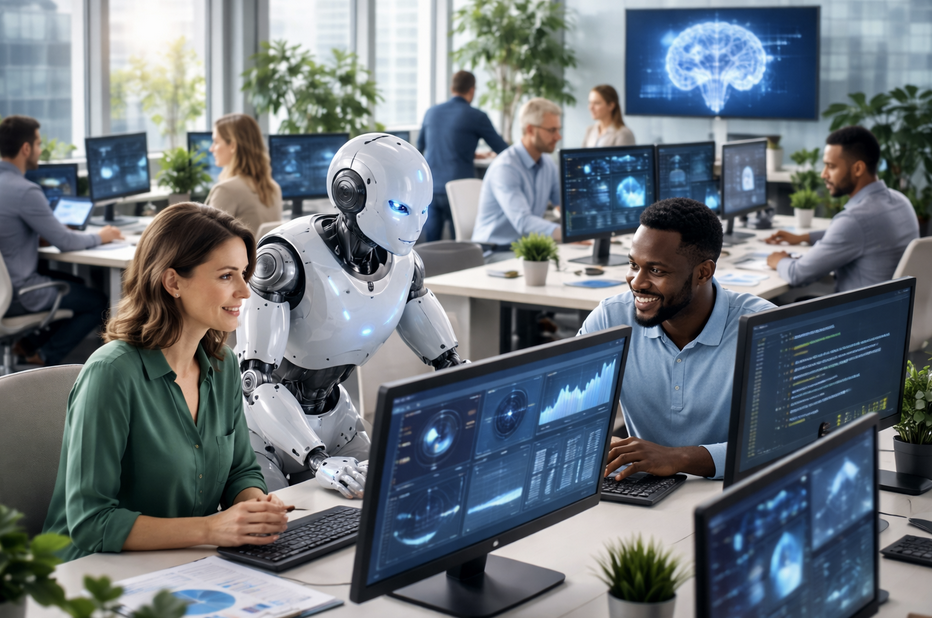
Rather than replacing people, the most effective AI strategies are built explicitly around augmentation – amplifying human capability rather than substituting for it. This is where the concept of “human-in-the-loop” becomes not just ethically important but strategically essential.
In this model, AI and humans play complementary roles. AI handles the tasks that reward speed, scale, and consistency. Humans provide judgment, contextual understanding, and accountability for decisions that matter. In hiring, AI can rank candidates based on skills and experience with perfect consistency, while a human assesses cultural fit and makes the final decision. In onboarding, AI generates documents and checklists, while a human ensures they’re accurate, personalized, and actually understood by the new employee. In compliance, AI tracks requirements and flags potential gaps, while a human validates and takes responsibility for execution.
This balance isn’t just emerging as a best practice for ethical reasons – though that matters. It’s winning because it produces better business outcomes. It reduces risk while improving speed. It catches problems that pure automation would miss while avoiding the bottlenecks of pure human processing.
What This Means for SMBs: A Competitive Opportunity
For small and mid-sized businesses, the implications are significant and ultimately empowering. You don’t have the luxury of large teams, redundant systems, or specialized departments handling each function. Every decision, every hire, every process carries outsized consequences. You can’t afford mistakes that large organizations can absorb.
But that constraint is also your advantage. AI presents a genuine opportunity to compete with larger organizations by moving faster without proportional headcount increases. It reduces costly errors and inefficiencies that disproportionately hurt small budgets. It helps you stay compliant in an increasingly complex regulatory environment where non-compliance is uniquely dangerous for resource constrained businesses.
But only if it’s implemented correctly. The goal should never be to replace your team. The goal should be to amplify what your team can do – freeing them from grunt work so they can focus on the judgment calls, relationship building, and strategic thinking that actually drives business results.
The most important mindset shift SMB leaders can make is moving from “Where can AI replace work?” to “Where can AI remove friction and improve how work actually gets done?” This reframes AI from a cost cutting tool into a growth enabler. And it aligns with what we’re seeing in the market: companies that invest thoughtfully in both technology and people outperform those focused on one alone. Teams that feel supported by AI, rather than threatened by it, are more engaged and effective. Organizations that maintain human oversight reduce risk while improving outcomes.
The Future Is Hybrid
As we move deeper into 2026, one thing is becoming increasingly clear: the future of work is not a competition between humans and AI. It’s human working alongside AI.
The companies that will win aren’t the ones that automate the most aggressively. They’re the ones that integrate the smartest. They use AI to handle volume and complexity while keeping humans in control of decisions that carry real consequences. They build systems that are both efficient and compliant, both fast and fair. They create environments where technology supports people – expanding what they can accomplish – rather than replacing them.
For SMBs willing to take this human-centric approach, AI offers something far more powerful than mere automation: clarity about where your business is strong, capability to move faster without burning out your team, and the ability to grow sustainably without breaking what already works.
The question isn’t whether to adopt AI. It’s how to adopt it in ways that make your business and your people stronger.
Keywords: AI in HR, AI and workforce, SMB productivity, human-in-the-loop, AI automation, HR technology, future of work, AI compliance, workforce transformation, AI hiring tools, productivity paradox, Intelligent DataWorks
Recent Comments