
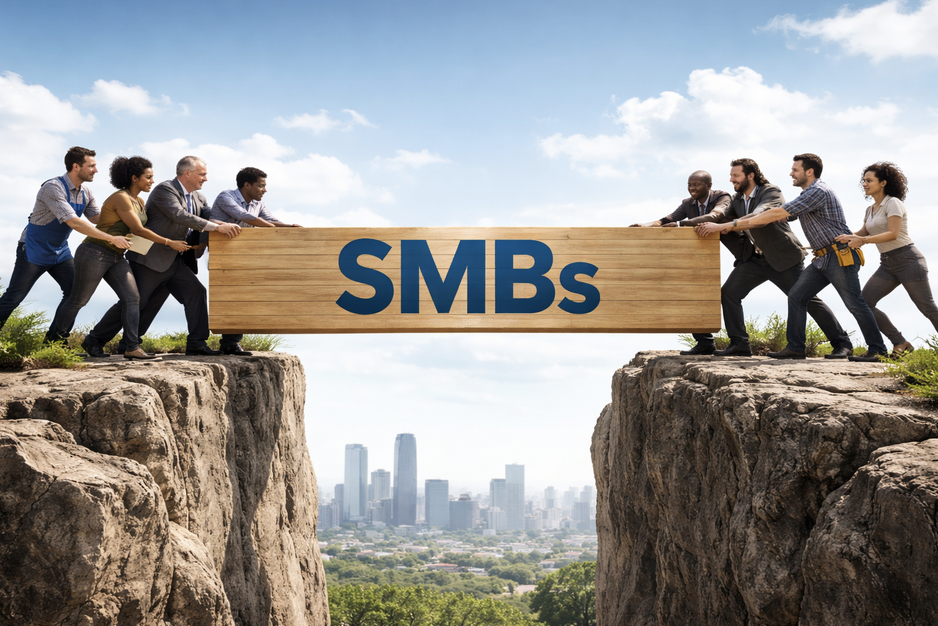
For small and mid-sized businesses, 2026 is emerging as a genuine inflection point – a moment when the accumulation of technological advancement, regulatory complexity, and competitive pressure creates conditions that demand fundamental operational evolution rather than incremental adjustment. The velocity of change has accelerated beyond what traditional management approaches can absorb comfortably, leaving many business leaders caught in an uncomfortable tension between recognizing the necessity of innovation and fearing the disruption that transformation inevitably brings.
The challenge isn’t that SMB owners and operators resist progress or fail to understand technology’s potential value. Most clearly recognize that their current operational approaches cannot sustain indefinitely in an environment where competitors leverage intelligent systems, where regulatory frameworks grow more complex annually, and where talent expects modern tools and processes. The fundamental anxiety centers not on whether to modernize but on how to accomplish transformation without sacrificing the authentic human relationships, organizational culture, and operational stability that define small business advantages.
Because unlike large enterprises that can afford parallel systems during transitions, dedicated change management teams to shepherd adoption, and financial buffers to absorb implementation friction, small and mid-sized businesses operate without these safety nets. They can’t afford extended periods of reduced productivity while new systems stabilize. They can’t risk alienating key employees who might leave rather than adapt to unfamiliar tools. They can’t write off failed technology investments as learning experiences and move on to the next attempt. For SMBs, transformation must work the first time – or at least close enough that course corrections happen quickly before damage accumulates.
This operational reality shapes how thoughtful SMBs approach modernization: not as comprehensive overnight replacement of everything familiar but as strategic evolution that builds capability progressively while preserving what actually works and matters.
When Familiar Systems Become Operational Liabilities
Across industries and business models, countless small and mid-sized businesses continue running core operations through patchwork combinations of spreadsheets shared via email or network drives, disconnected single purpose applications that don’t communicate with each other, manual processes documented in binders or institutional knowledge that exists nowhere except current employees’ memories, and legacy software systems that “still work” despite requiring elaborate workarounds to accomplish tasks that modern platforms handle natively.
These accumulations of familiar tools and established processes were never designed as integrated systems. They evolved organically as businesses added capabilities incrementally – implementing an accounting package here, adopting a scheduling tool there, creating a spreadsheet to track something that no existing tool addressed. Each addition made sense in isolation, solving an immediate problem with available resources and knowledge. But the cumulative result creates operational fragility disguised as comfortable familiarity.
The problem extends beyond mere technical limitations. These legacy environments create cultural inertia that resists change even when current approaches demonstrably underperform. Teams develop expertise in coaxing productivity from inadequate tools, building identity and job security around knowledge of how to make broken systems function. Suggesting replacement feels like devaluing that hard won expertise, triggering resistance rooted in self preservation rather than thoughtful evaluation of alternatives.
Yet every month that outdated systems remain in place, the hidden costs compound. Hours disappear into reconciling data discrepancies between platforms that should share information automatically. Forms get re-entered manually because systems don’t integrate. Errors proliferate because verification depends on human vigilance rather than systematic validation. Compliance gaps emerge because tracking depends on whoever remembers to update the tracking spreadsheet. Strategic opportunities get missed because leadership lacks timely, accurate operational data.
The manual processes underlying these environments impose what might be called an operational tax, continuous drains on productivity and capacity that aren’t visible on any budget line but that meaningfully constrain what organizations can accomplish with available resources. As AI-enabled platforms become more modular in their architecture and easier to integrate with existing systems, the traditional barriers to modernization have diminished substantially. SMBs no longer face binary choices between comprehensive replacement and indefinite stagnation. They can pursue strategic evolution, starting with areas experiencing the most acute pain and building from demonstrated successes.
Navigating AI Adoption With Appropriate Skepticism
AI adoption across small and mid-sized businesses is accelerating rapidly, but healthy skepticism accompanies the enthusiasm. SMB owners and managers understand intuitively that transformative technologies carry both tremendous promise and genuine risks that demand careful evaluation rather than uncritical embrace.
The concerns aren’t irrational or technophobic. Questions about algorithmic bias reflect legitimate awareness that AI systems can encode and amplify the prejudices present in their training data, potentially creating systematic discrimination that damages both individuals and organizations. Worries about accuracy acknowledge that even sophisticated systems make errors, and that over-reliance on flawed recommendations can prove costly. Accountability anxieties recognize that when something goes wrong with AI-assisted decisions, determining responsibility and implementing corrections becomes complicated in ways that manual processes, however inefficient, never created.
Perhaps the most visceral concern involves the fear that AI adoption means replacing people with algorithms, eliminating the human judgment and relationship capabilities that define small business competitive advantages. This anxiety isn’t entirely unfounded given how automation has historically eliminated entire job categories, but it reflects incomplete understanding of how thoughtfully designed human-centric AI actually functions in practice.
The next generation of genuinely human-centered AI platforms addresses these concerns architecturally rather than just rhetorically. These systems are built from inception around the principle that technology should support human judgment rather than replace it, handle repetitive mechanical work rather than eliminate the roles requiring that work gets done, and maintain transparency rather than operating as opaque black boxes. When designed correctly, AI becomes what might be thought of as a capable assistant that monitors compliance changes across jurisdictions you operate in, evaluates candidate qualifications against job requirements without demographic bias, automates repetitive documentation that consumes hours without requiring creativity, and prepares recommendations with clear reasoning while keeping humans firmly in control of consequential decisions.
The goal isn’t replacing the HR generalist who understands organizational culture and employee needs. It’s giving that person superpowers through systems that handle the administrative burden preventing them from focusing on the strategic and relational work where they create genuine value. The operations manager doesn’t become obsolete – they become more effective when freed from manual data reconciliation and enabled to focus on process improvement and team development.
The distinction between effective and problematic AI implementation often comes down to transparency, explainability, and auditability. Systems that can articulate how they reached recommendations, that maintain comprehensive logs of all actions and decision points, and that require meaningful human review rather than perfunctory approval build the trust necessary for successful adoption. These aren’t black boxes producing mysterious outputs that users must either accept on faith or reject entirely. They’re tools that show their work, justify their suggestions, and subordinate themselves to human authority.
The Compliance Complexity Creating Urgent Need
Even as technology capabilities evolve, the regulatory environment governing employment, data privacy, workplace safety, and business operations generally has grown dramatically more complex and fragmented. Minimum wage increases cascade across states and municipalities on different timelines and with varying provisions. Pay transparency laws emerge with jurisdiction specific disclosure requirements and penalty structures. AI bias audit mandates apply in some states but not others. Data privacy frameworks proliferate with overlapping but non-identical obligations around consent, access, deletion, and breach notification.
For small and mid-sized businesses, this patchwork regulatory landscape creates compliance challenges that consume disproportionate resources relative to organizational size. A policy perfectly compliant in Texas might violate California law. An HR practice that satisfies federal requirements could trigger violations of state-specific provisions. Employment contracts legally sound in one jurisdiction might be unenforceable or prohibited in another. Because most small teams lack dedicated legal staff or compliance specialists, navigating this complexity often means exactly what you described: late-night internet research, consultation with similarly confused peers, and hoping that good faith efforts prove sufficient if challenged.
The financial exposure from getting compliance wrong continues escalating. Wage and hour violations can trigger penalties that multiply based on affected employees and violation duration. Misclassification of workers as independent contractors can result in back-pay obligations for wages, overtime, and benefits spanning years. Data privacy breaches can generate fines calculated per record exposed or per day of non-compliance. The cumulative penalties from multiple concurrent violations can genuinely threaten small business viability, while the reputational damage that accompanies enforcement actions can prove even more devastating than direct financial costs.
This convergence of complexity and consequence creates perhaps the most urgent and straightforward use case for digital transformation: automation as compliance insurance. Modern HR platforms can continuously monitor regulatory changes across relevant jurisdictions without requiring humans to track dozens of agency websites and regulatory bulletins. They can automatically flag when updates affect organizational policies or practices and require human review. They can centralize compliance documentation in systematically organized, audit-ready repositories that eliminate the frantic scrambling that typically precedes regulatory reviews.
The value proposition isn’t theoretical or speculative – it’s immediate and measurable through reduced compliance anxiety, decreased time spent on regulatory research and documentation maintenance, and lower probability of costly violations.
Human-Centric Design as Bridge Between Technology and Trust
The most successful AI implementations in SMB contexts recognize that adoption isn’t purely about efficiency gains or cost reduction, it’s fundamentally about protecting people and enabling businesses to operate sustainably in increasingly complex environments. Well designed HR platforms deliver what resource constrained teams need most: clarity about what’s changing in regulatory frameworks that affect their operations, and confidence that every record, policy document, and workflow meets current standards without requiring constant manual verification.
More importantly, these systems ensure that humans remain in control of decisions while technology handles the preparation work that makes good decisions possible. AI can manage the routine mechanical tasks like monitoring wage threshold updates across jurisdictions, identifying when classifications need review, flagging approaching compliance deadlines, and generating required documentation. This frees HR professionals to focus on the uniquely human work that actually builds organizational capability: coaching managers through difficult employee situations, designing engagement initiatives that strengthen culture, developing retention strategies that address root causes of turnover, and providing the responsive support that makes employees feel valued.
When compliance becomes systematically managed through technology rather than hoped for through human diligence, accountability becomes sustainable rather than exhausting. Teams can maintain rigorous standards without burnout. Organizations can scale operations without proportionally scaling compliance risk. Leadership can make strategic decisions with confidence that operational foundations remain sound.
This represents how SMBs will thrive in 2026’s more complex environment, not by somehow doing more work with the same constrained resources, but by leveraging intelligent systems that make smarter work possible.
Charting Your Transformation Journey
Every organization’s modernization path will necessarily look different based on current systems, acute pain points, available resources, and strategic priorities. For some businesses, transformation starts with eliminating paper-based forms that create filing nightmares and information access barriers. For others, it means consolidating payroll, onboarding, and compliance tracking into unified platforms that maintain single sources of truth. Many will focus initially on the specific workflows consuming disproportionate time or creating the most frequent errors.
The guiding principle involves starting where technology delivers the clearest human benefit – where automating mechanical work reclaims capacity that can be redirected toward activities requiring judgment, creativity, and relationship building. This might be candidate screening that currently consumes entire days manually reviewing applications. It might be onboarding documentation that demands hours of form preparation and tracking. It might be compliance monitoring that creates constant anxiety about what might be falling through cracks.
The goal extends beyond making existing work faster through technological acceleration. At its best, thoughtful technology adoption makes work genuinely better by giving people room to think strategically rather than merely execute tactically, to create innovative approaches rather than perpetuate established patterns, and to connect authentically with colleagues, customers, and communities while ensuring that compliance requirements and operational consistency never slip through the cracks.
2026 is kicking off with its convergence of regulatory complexity, competitive pressure, and technological capability, one principle stands out with particular clarity: the future of successful SMB operations won’t be defined by choosing between preserving human judgment and embracing technological capability. Instead, it will be characterized by making them stronger together using intelligent systems to amplify rather than replace human contributions, to extend rather than eliminate judgment, and to enable rather than constrain the authentic relationships and organizational culture that define small business competitive advantages.
For organizations willing to approach modernization thoughtfully rather than either resisting indefinitely or adopting uncritically, the opportunity to build genuinely sustainable operational capabilities has never been more accessible or more urgent.
Keywords: AI in HR, SMB digital transformation, HR automation, legacy system integration, compliance automation, multi-state compliance, human-centric AI, labor law 2026, data privacy, regulatory readiness, payroll modernization, HRIS adoption, Intelligent DataWorks, workforce accountability.
Recent Comments