
For many small and mid-sized businesses, compliance used to be straightforward and relatively predictable. Employers primarily needed to understand federal labor laws, ensure internal policies aligned with those requirements, and periodically update their handbooks. The framework was clear: federal law set the baseline, and you built your practices around it.
That model no longer reflects the actual regulatory environment most SMBs operate in today.
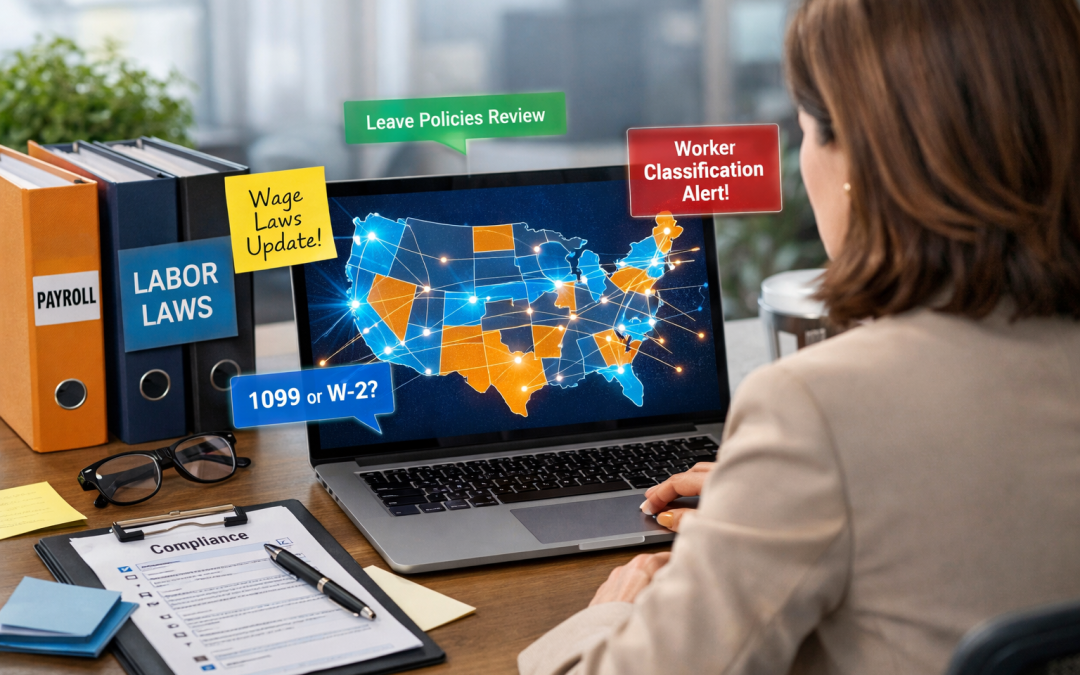
Across the United States, labor and employment regulations are increasingly being created and enforced at the state and local level rather than through a single federal framework. While federal law still establishes a baseline, a growing number of states – and even individual cities in some cases – are introducing their own rules governing wages, hiring practices, worker classification, and employee benefits. Many of these state-level rules are more stringent than federal requirements, creating a patchwork of overlapping obligations. For SMBs, this shift has created a fundamentally new challenge: multi-state compliance complexity that grows exponentially more complicated with each distributed employee or remote hire.
And for organizations operating with distributed teams, remote employees, or even a handful of workers scattered across different states, that complexity isn’t just a management headache, it’s a source of serious legal and financial exposure.
The Shift Toward Decentralized Labor Regulation
Over the past decade, state legislatures have taken increasingly active roles in shaping labor policy that often reflects local economic priorities or worker protections that explicitly go beyond federal standards. California sets its own minimum wage different from federal minimums. New York has its own paid leave requirements. Massachusetts maintains unique overtime rules. Colorado enforces strict independent contractor standards. Each state is essentially experimenting with its own labor policy framework, and the result is a genuinely fragmented regulatory landscape.
The examples illustrate the scope of variation: state-specific minimum wage increases that can differ dramatically (California’s minimum is substantially higher than the federal floor; some states follow federal baseline). Pay transparency requirements in job postings that vary by jurisdiction (California requires it; other states don’t, but some employers working across states must comply with the strictest standard). Expanded paid leave programs that each include unique eligibility rules and accrual formulas. Worker classification enforcement that intensifies scrutiny of contractor relationships. Data privacy protections that specifically govern how employee records can be handled and stored.
For large enterprises with dedicated legal departments and compliance teams, tracking these variations is difficult but manageable because they have resources dedicated to staying current. For SMBs with lean teams, often just one or two HR professionals managing everything from recruiting to benefits to payroll, the burden becomes substantial and genuinely overwhelming. The same company may face entirely different obligations for employees performing essentially identical roles in different states. An HR policy that’s fully compliant in one state might violate requirements in another. A compensation structure that works fine in your headquarters state might create wage violations in a state where an employee works remotely.
Remote Work Has Made This Urgently Real
The rise of remote and hybrid work has accelerated this compliance challenge from a future problem into an immediate crisis for many SMBs.
Historically, most small and mid-sized businesses operated within a single state or regional area, which meant their compliance obligations were relatively consistent and manageable. But the shift to distributed work has fundamentally changed hiring dynamics. Today, many SMBs employ staff who live and work across multiple states – even if the company itself maintains only one physical office or headquarters. A startup in Texas can now hire engineers in Colorado, account managers in New York, and customer service staff in Florida, all working remotely for one small company. This flexibility benefits both employers and employees enormously, but it also introduces compliance considerations that most SMBs weren’t equipped to handle.
When an employee works remotely from another state, that state’s labor laws generally apply to the employment relationship – and the implications extend across nearly every operational area. Minimum wage requirements differ by state, and you must pay the highest applicable wage. Overtime eligibility rules vary, changing how you calculate compensation. Payroll tax obligations shift based on where employees actually work, not where they’re hired from. Workplace postings and notices required in one state may be unnecessary in another, but failure to post required notices creates liability. Paid leave accrual rules differ dramatically – some states mandate specific accrual rates, others require different calculations. Final paycheck requirements vary, determining exactly when and how you must pay departing employees.
In some cases, businesses unknowingly become subject to regulations in jurisdictions they had never previously considered when they hired their first employee in that state. For HR teams already stretched thin managing recruiting, onboarding, performance management, and payroll simultaneously, keeping mental track of these obligations across multiple states is neither realistic nor sustainable.
Worker Classification Enforcement Is Intensifying
Another area creating significant compliance complexity is worker classification – how you categorize employees versus independent contractors. As businesses increasingly rely on contingent workers, freelancers, and project-based talent to maintain flexibility, regulators have intensified enforcement around classification accuracy. Misclassification – treating someone who should be an employee as an independent contractor – can result in substantial back pay liability, tax penalties, and legal exposure.
What makes this more complex is that different states apply different classification tests, and some state standards are significantly stricter than federal guidelines. Certain states apply variations of the “ABC test,” which requires employers to demonstrate three specific things: that the worker operates as an independent business (A), that they perform work outside the company’s normal business activities (B), and that they’re customarily engaged in an independently established business (C). If all three conditions aren’t clearly met, the worker legally qualifies as an employee under that state’s law. For SMBs managing project-based teams or contingent workforces, ensuring proper classification requires careful documentation, ongoing review, and genuine understanding of state-specific tests. One misclassification discovered during an audit can expose the entire contractor arrangement to scrutiny.
Pay Transparency Requirements Are Reshaping Hiring
Pay transparency legislation represents another major shift that directly affects how SMBs recruit. Several states now require employers to disclose salary ranges in job postings or provide pay information to candidates upon request. These laws aim to address pay equity concerns and promote greater transparency in hiring practices, which is well-intentioned, but compliance creates practical headaches for businesses recruiting across multiple states.
Here’s the real-world challenge: a job posting that’s visible online to candidates nationwide may technically need to meet the requirements of any state where applicants might reasonably apply. This means companies hiring remotely must consider how their compensation disclosures align with rules in various jurisdictions. Failing to disclose salary ranges where required, or disclosing them where prohibited, creates both legal risk and practical hiring complications. For SMBs trying to maintain consistent hiring practices across multiple states, this requires either customizing postings by geography or adopting the most stringent standard across all postings.
Paid Leave Programs Create Administrative Complexity
Paid leave policies represent another area where state laws are evolving rapidly and creating genuine administrative burden. While federal law provides limited guidance on paid leave, many states have introduced sophisticated programs covering paid family leave, paid sick leave, caregiver leave, and safe leave for domestic violence situations. Each program typically includes unique eligibility rules, different accrual formulas, specific documentation requirements, and distinct employee notification obligations.
For businesses operating in multiple states, these variations create a genuinely complicated administrative puzzle. HR teams must ensure that leave policies comply with each applicable jurisdiction while simultaneously maintaining enough consistency across the organization that employees feel treated fairly. A leave policy that works perfectly for your Colorado employees might be insufficient for Massachusetts employees, and you’re not allowed to offer less than the state-mandated minimum in any location.
Payroll Compliance Remains a Critical Vulnerability
Payroll compliance creates another area where multi-state operations generate serious risk. Different states impose distinct requirements regarding minimum wage levels, overtime calculations, wage payment schedules, payroll deductions, and final paycheck timing. Even small discrepancies can trigger compliance issues that accumulate into significant liability.
For example, a company headquartered in one state might unknowingly apply its home-state payroll policies to employees in another jurisdiction where wage laws differ substantially. If discovered during an audit, employee complaint, or regulatory investigation, the company could face penalties, back pay obligations spanning years, or legal disputes that cost far more than any oversight would have.
Why the Burden Falls Disproportionately on SMBs
Here’s where the fairness issue becomes clear: large enterprises often employ specialized compliance teams, dedicated legal counsel, and HR professionals whose sole responsibility is regulatory oversight. They have resources to track changes, interpret requirements, and implement systems. Small and mid-sized businesses typically do not.
Instead, compliance responsibilities frequently land on HR managers already managing recruiting and onboarding, finance leaders handling accounting and tax obligations, operations teams coordinating vendors and logistics, or sometimes founders trying to oversee everything. These individuals are already juggling multiple priorities with limited bandwidth. As the regulatory landscape becomes increasingly fragmented and state regulations change constantly, the amount of time required simply to monitor and interpret new rules continues growing exponentially. It’s not that SMB leaders don’t care about compliance – they absolutely do. It’s that the system is designed assuming organizations have specialized compliance infrastructure that most small companies simply don’t have.
Technology as Essential Infrastructure, Not Optional
Given the accelerating pace of regulatory change, many SMBs are recognizing that manual compliance management including spreadsheets, email chains, and hope — is no longer sustainable or responsible. Modern HR technology platforms are increasingly designed to solve exactly this problem by tracking labor law updates across jurisdictions automatically, centralizing employee records and documentation in auditable systems, maintaining consistent hiring and onboarding workflows regardless of state, monitoring classification and compensation policies continuously, and creating audit-ready documentation automatically.
When implemented thoughtfully, these platforms significantly reduce administrative burden while helping businesses maintain genuine oversight. Importantly, the most effective solutions operate on a human-centric model: they don’t replace HR professionals, they provide the structure and visibility that allows those professionals to make informed decisions confidently. In an environment where regulations continue evolving, technology serves as a critical bridge between compliance requirements and the day-to-day operational reality of running a business.
The Competitive Opportunity Hidden in Complexity
The growing complexity of multi-state labor laws may seem like a pure obstacle for SMBs, but organizations that build strong compliance processes and systems early can gain meaningful advantages. These businesses operate with greater operational consistency because they’re not making different decisions in different states based on inconsistent information. They carry reduced legal and financial risk because they’re catching compliance gaps before regulators do. They build improved employee trust through transparency about how they’re managed fairly across locations. They develop stronger reputations with partners and customers who increasingly expect compliance maturity.
Instead of viewing multi-state compliance as a reactive task to minimize, forward-thinking SMBs are treating it as a core operational capability that supports growth. By investing in systems and processes that keep pace with regulatory change, these organizations position themselves for sustainable expansion, even as the labor landscape continues evolving in ways that create challenges for competitors still relying on manual oversight.
The businesses that thrive will be those that recognize multi-state compliance not as a burden to avoid, but as a strategic capability to build.
Keywords: multi-state compliance, SMB HR compliance, labor law compliance, pay transparency laws, worker classification compliance, remote workforce compliance, HR automation, payroll compliance, distributed workforce management, HR technology for SMBs, human-in-the-loop HR systems, employment law compliance, Intelligent DataWorks
Recent Comments