
Hiring the right talent has always been a challenge for small and mid-sized businesses (SMBs). Between passive recruiting—where recruiters actively reach out to potential candidates—and active recruiting—where businesses must sift through hundreds or even thousands of applications—finding the right person for the job can be overwhelming.
Traditional recruitment methods are often inefficient, expensive, and time-consuming, leading to lost productivity and missed opportunities. But in 2025, AI-driven recruitment is changing the game for SMBs, making hiring faster, more precise, and cost-effective.
The Challenge: Too Many Candidates, Too Little Time
Recruiting for SMBs is a balancing act. On the one hand, passive recruiting requires time-intensive outreach, where talent acquisition teams manually identify and message candidates who may not even be actively looking for a job. This method can be highly effective in attracting top talent, but it’s also incredibly resource-heavy when done manually.
On the other hand, active recruiting means dealing with an influx of applications—many of which are not a good fit. An Applicant Tracking System (ATS) can filter out obvious mismatches by scanning for keywords and basic qualifications, but this still leaves hundreds of resumes for recruiters to manually review. Studies show that traditional ATS systems weed out around 70-80% of applicants, but that still means recruiters may have to sift through 200 to 300 resumes per job posting.
With so many applications to review, resume fatigue becomes a real issue. After reviewing hundreds of candidates, even the best recruiters can start missing key details, leading to great candidates being overlooked. This is where AI-driven recruitment steps in.
How AI Is Revolutionizing SMB Hiring
1. Smarter Candidate Matching
AI goes beyond simple keyword scanning—it analyzes entire resumes, identifying not just qualifications but also skills, experience, and even soft skills that make a candidate a strong fit. Unlike a traditional ATS, AI-driven systems can interpret the context of past work experience, evaluating candidates based on career progression, relevant industry knowledge, and cultural fit.
For example, if a candidate has worked in customer service in multiple industries, an AI-powered system can identify transferable skills, even if the job title doesn’t perfectly match the hiring criteria.
2. Automated Passive Recruiting
AI recruitment tools are also revolutionizing passive hiring strategies by automatically identifying and reaching out to potential candidates. Instead of manually searching LinkedIn or job boards, AI can scan vast amounts of public data, identifying professionals who match a company’s hiring needs and even drafting personalized outreach messages.
Recruiters no longer have to spend hours manually searching for candidates—AI works 24/7, continuously finding and engaging with top talent.
3. AI-Powered Screening and Shortlisting
With traditional ATS systems, recruiters still need to manually review hundreds of resumes after initial filtering. AI eliminates this extra workload by ranking and scoring candidates based on their likelihood of success in a role.
AI can assess not just qualifications but also factors like:
• Work history progression
• Industry relevance
• Predicted performance based on past hires
• Cultural fit within the organization
For SMBs, this means that instead of spending days filtering resumes, AI delivers a short, high-quality list of candidates, saving recruiters countless hours.
4. Reducing Resume Fatigue and Bias
One of the biggest challenges recruiters face is resume fatigue—the decline in decision-making quality after reviewing too many applications. When fatigue sets in, even the most qualified candidates may be overlooked. AI never tires, ensuring every application is evaluated consistently and fairly.
Additionally, AI helps eliminate unconscious bias in hiring. While human recruiters may unintentionally favor certain candidates based on name, gender, or background, AI focuses solely on data-driven insights, ensuring that hiring decisions are based on merit, not personal biases.
The Business Impact: Time, Money, and Resources Saved
For SMBs, AI-driven recruitment isn’t just about making hiring easier—it’s about making businesses more efficient, competitive, and cost-effective.
✔ Faster Hiring: AI reduces time-to-hire by weeks, ensuring companies secure top talent before competitors.
✔ Lower Costs: With fewer manual hours spent on recruitment, businesses save on overhead costs.
✔ Improved Candidate Quality: AI-driven selection ensures better hires, reducing turnover and increasing employee retention.
✔ More Time for HR Strategy: Instead of getting buried in resumes, HR teams can focus on employee engagement, training, and retention strategies.
As AI-powered recruitment tools become more accessible, SMBs can now leverage the same sophisticated hiring capabilities as large enterprises, leveling the playing field in the race for top talent.
The Future of AI-Driven Hiring
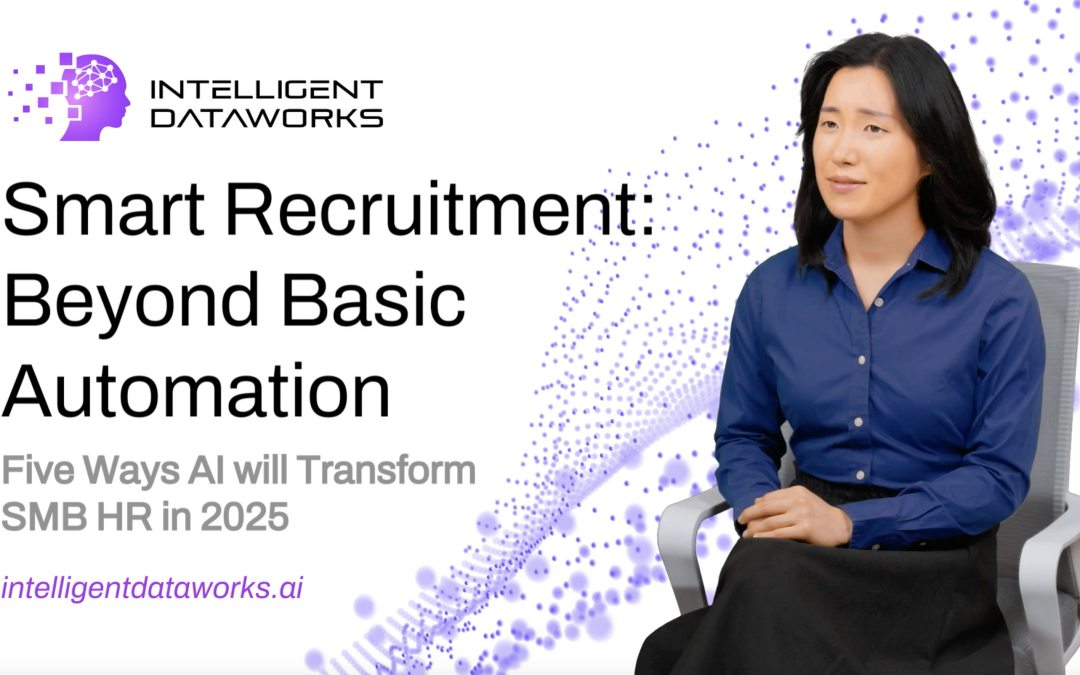
As Jennifer from Intelligent DataWorks explains in our video, AI-powered hiring isn’t just automation—it’s a strategic advantage. AI understands what makes a great hire, predicts future performance, and helps SMBs attract and retain the best employees.
With AI, recruitment in 2025 isn’t about guesswork—it’s about precision, efficiency, and better business outcomes. If your SMB wants to compete for top talent, AI-driven recruitment is the key to success.
📢 Watch the full video and learn more about AI-powered hiring here:
Keywords:
AI recruitment, SMB hiring, AI-driven hiring, passive recruiting automation, applicant tracking AI, AI hiring tools, HR automation, AI-powered candidate selection, resume screening AI, HR technology 2025.
Recent Comments